


Bernard and Arthur Bohn

Passionate winemakers Bernard and Arthur Bohn carry on the family’s winemaking tradition, which has been established in Reichsfeld for almost three centuries. There, they cultivate vines on hillsides at an altitude of between 300 and 400 metres, on a schist terroir that is unique in Alsace. The vines draw their minerality from the oldest terroir in Alsace, dating back to the Precambrian era (500 million years ago).
This soil, rich in nutrients, produces wines that are distinctive, elegant and well-structured. The wines from this terroir are characterised by their finesse and freshness on the palate. Somewhat reserved in their youth, they begin to reveal their true character after three years. They then develop further after six years, maturing into fine wines with excellent ageing potential, and truly impress after ten or fifteen years.
Sparkling wines (Crémants)


White Wines
-
 Bernard et Arthur Bohn
Alsace
En Vrac13.00 € -

 Bernard et Arthur Bohn
Alsace
Muscat 202317.00 € -
 Bernard et Arthur Bohn
Alsace Riesling
Terroir de Schiste 202318.00 € -
 Bernard et Arthur Bohn
Alsace
Muscat Par NAthur 2020Original price was: 20.00 €.18.00 €Current price is: 18.00 €. -
 Bernard et Arthur Bohn
Alsace Gewurztraminer
201820.00 € -
 Bernard et Arthur Bohn
Alsace Pinot Gris
Schieferberg 202125.00 € -
 EpuiséBernard and Arthur Bohn:
Alsace
by the bottle26.00 € -
 Bernard et Arthur Bohn
Alsace Riesling
Chapelle Oberhagel 202132.00 € -
 EpuiséBernard et Arthur Bohn
Alsace Grand Cru
Muenchberg 202232.00 € -
 Bernard et Arthur Bohn
Alsace Pinot Gris
Sélection de Grains Nobles 199745.00 €
Macerated Wines (Orange Wines)


Red Wines


Spirits
-

 Bernard et Arthur Bohn
Eau-de-Vie
PoireOriginal price was: 50.00 €.45.00 €Current price is: 45.00 €. -
Bernard et Arthur Bohn, Eau-de-Vie MirabelleOriginal price was: 50.00 €.45.00 €Current price is: 45.00 €.
-
 Bernard et Arthur Bohn, Marc de GewurztraminerOriginal price was: 50.00 €.45.00 €Current price is: 45.00 €.
 -
 Bernard et Arthur Bohn, Eau-de-Vie KirschOriginal price was: 50.00 €.45.00 €Current price is: 45.00 €.
 -
 EpuiséBernard et Arthur Bohn, Eau-de-Vie Framboise50.00 €
 -
 EpuiséBernard et Arthur Bohn, Golden Time Brandy60.00 €
 -
 EpuiséBernard et Arthur Bohn, Eau-de-Vie Quetsch60.00 €
 -
 Bernard et Arthur Bohn
Whisky
HornockxOriginal price was: 75.00 €.67.50 €Current price is: 67.50 €.
The Bernard and Arthur Bohn estate benefits from exceptional terroirs in Alsace
The Schieferberg
A unique terroir in Alsace, situated on a steep south- and south-east-facing slope, sheltered by the Ungersberg massif, which rises to 901 metres. It is within this layered rock formation, composed of Villé blue schist formed by the compression of clay within the Earth’s crust, that the stones accumulate heat during the day and release it at night. The Schieferberg Zéro cuvée is a splendid expression of this terroir through maceration.
The Oberhagel
It is situated right in the heart of the Schieferberg, traditionally harvested when the grapes are slightly overripe. Whilst favouring a dry vinification style to produce a wine for fine dining. The Riesling offers aromas of candied citrus, aniseed and mint, with a flinty minerality. The Pinot Gris features aromas of quince. On schist, Riesling reigns supreme. Two cuvées bear this out: the estate’s signature Riesling Oberhagel and the Riesling Nature.
The Sohlenberg, the Muenchberg Grand Cru and the Sauthal
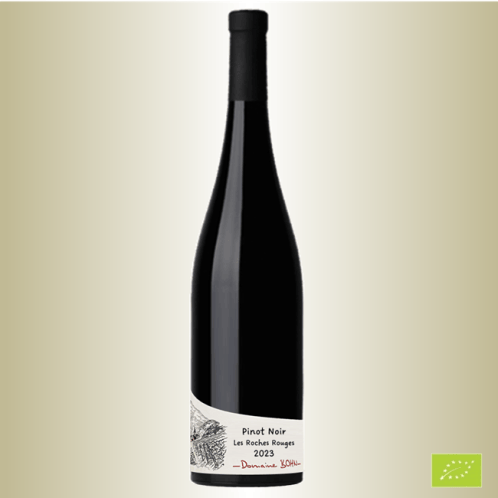
These are terroirs of pink, volcanic sandstone. Like the Schieferberg, the soil is well-drained, aerated and warms up quickly. The Riesling expresses itself through aromas of white flowers and pineapple, with a hint of minerality. This red soil also suits Pinot Noir perfectly, giving it that raspberry note. Vinified as a red and aged in barrels, it produces wines that are both elegant and powerful, with aromas of blackberry, blueberry and black cherry.
From environmental protection to organic farming
Bernard and Arthur Bohn cultivate their schist and volcanic sandstone soils using environmentally friendly and organic methods.
They manage their soil with great care. The diversity and preservation of the local flora and fauna is fundamental to the estate’s vineyard. Native vegetation covers the ground; the grass is not mown but rolled into a green carpet. Here, chemicals are avoided through the practice of ecological and organic viticulture that respects the environment. As independent winegrowers, Bernard and Arthur Bohn follow their own path.
Bernard and Arthur Bohn deliberately keep yields low and harvest all their wines by hand. Bernard is also the estate’s oenologist. A stickler for quality, he explains that wine must reflect, without artifice, the terroir and climate from which it originates. He advocates a minimalist winemaking approach, free from oenological additives. For the majority of the vintages, vinification concludes with a long ageing period in old Alsatian casks or barrels to achieve the balance and persistence of fine dining wines; mineral, fresh, light, persistent and very easy to drink.
A few photos of the Bernard and Arthur Bohn estate


Excessive alcohol consumption is harmful to health; please drink in moderation.
In accordance with the Public Health Code, wines, sweet wines and beers have an alcohol content of between 3% and 18%